



TL;DR: CVE-2026-41089 is a zero-day vulnerability in Netlogon that lets an unauthenticated attacker execute code as SYSTEM on a domain controller with a single crafted network request. A working exploit emerged just 17 days after Microsoft shipped the patch, and the next critical flaw may be exploited before a patch even exists. Patching every domain controller immediately is the right first step, but patching alone is not a recovery strategy. When prevention fails, the ability to recover a clean, trusted Active Directory is what determines business impact.
On May 12, 2026, Microsoft shipped the fix for CVE-2026-41089, an unauthenticated remote code execution flaw in Windows Netlogon, and rated it less likely to be exploited. Just 17 days later, Belgium’s Centre for Cybersecurity told organizations the flaw was being used in attacks. By then, working exploit code was already public.
Seventeen days. Most organizations operate on monthly Patch Tuesday cycles, meaning a vulnerability disclosed today may not be addressed in their environment for 30 days or more. CVE-2026-41089 was being actively exploited before that first cycle even closed. That compressed timeline is what makes this zero-day vulnerability different. Plan for the next one to give you less time, because a flaw nobody has disclosed cannot be patched before it is used.
Quest Recovery Manager for Active Directory Disaster Recovery Edition is purpose-built for this scenario. When prevention runs out of runway, it automates the full forest recovery sequence and gets your directory back to a known-good state in a fraction of the time manual recovery requires.
What CVE-2026-41089 actually is
CVE-2026-41089 is a zero-day vulnerability and stack-based buffer overflow in Windows Netlogon, with a CVSS 3.1 base score of 9.8. An unauthenticated attacker on the network can execute code on a domain controller as SYSTEM with no prior access and no user interaction required. Everything from Windows Server 2012 to Server 2025 is affected, putting most production directories in scope.
The score is bad enough on its own. Where the bug lives makes it worse. Netlogon runs inside the Local Security Authority process on a domain controller, at the highest privilege the machine has. Reach SYSTEM there and you are inside the directory, able to read its secrets and write new records that every other system will trust. One controller left unpatched is a path to the whole forest.
How the zero-day vulnerability works
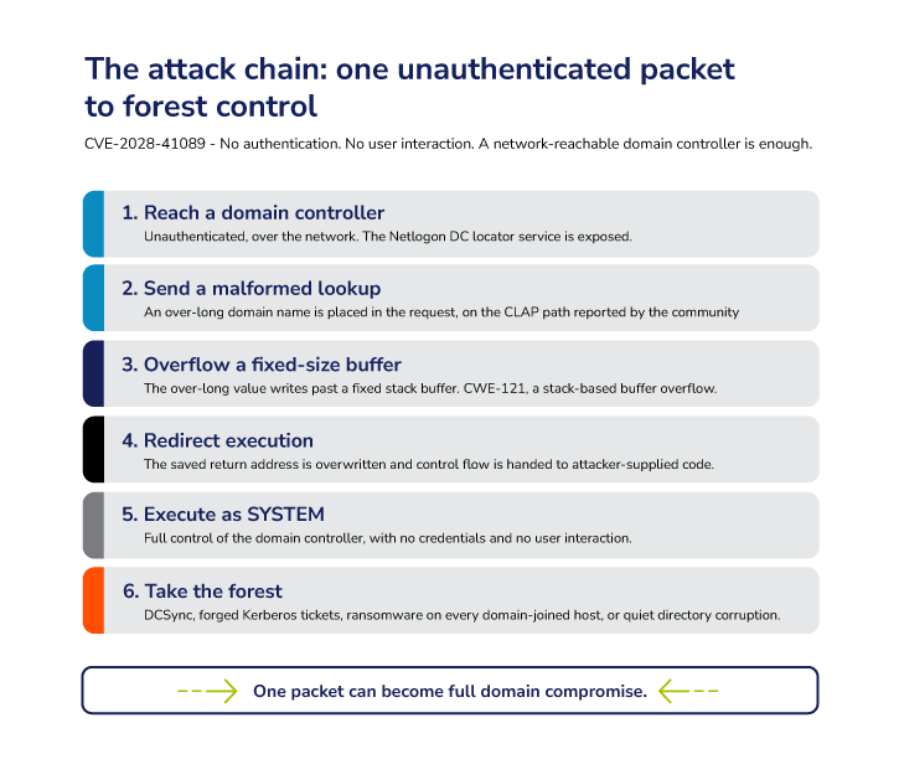
The starting position is the part that should concern you most. The attacker brings nothing, not even a stolen password. All they need is a domain controller that answers on the network.
To trigger the zero-day vulnerability, the attacker sends one malformed request carrying an over-long domain name where the code expects something short. The service copies that value into a fixed-size buffer on the stack without checking whether it fits. The write runs off the end of that buffer into the memory beside it, including the saved return address the function uses to find its way back when it finishes.
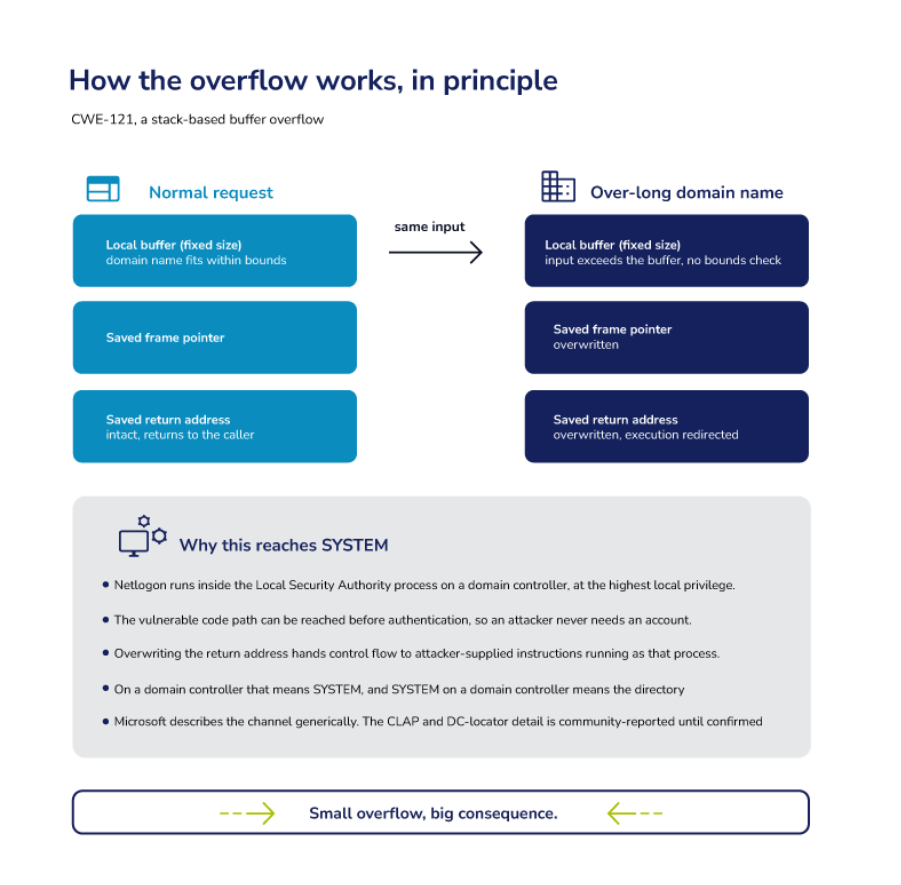
Control the return address and you control where the function goes next. You can jump into unintended instructions while still running inside the Netlogon process as SYSTEM. On a domain controller, SYSTEM is the directory itself, so an anonymous packet has just become full control of your identity platform.
The proof of concept and how to handle it
A working public exploit code exists, confirmed across several independent sources. A pre-authentication zero-day vulnerability on a domain controller with public proof of concept code is a mass-exploitation candidate. Bugs in this bracket usually make the jump from public PoC to real-world attacks inside 24 to 72 hours.
If you need to confirm your own exposure, ADScanPro’s LongLogon, is a non-destructive detector that tells you whether a controller is exposed without sending the overflow. Review the code as you would any third-party script before executing on your infrastructure.
- Non-destructive detector: github.com/ADScanPro/CVE-2026-41089-LongLogon
Patch every controller, in the same maintenance window
Apply the patch to every domain controller. If you miss one, the forest still has a pre-authentication hole on whichever controller you skipped. Patching four of five domain controllers does not buy you four-fifths of the safety.
Relevant KB articles from the MSRC advisory:
- Server 2012: KB5087470, and 2012 R2: KB5087471
- Server 2016: KB5087537, 2019: KB5087538
- Server 2022: KB5087545, and 2022 23H2: KB5087541
- Server 2025: KB5087539
While patching, watch for Netlogon service crashes or unexpected restarts, anomalous Netlogon traffic arriving from sources that are not domain controllers, and authentication or trust errors appearing after other suspicious activity. These signals will tell you something is wrong. What they cannot do is undo what has already happened.
Why this is really an Active Directory recovery problem
The patch shipped on May 12, rated unlikely to be exploited. Within a fortnight, there was public exploit code, and by the 29th, a national authority was warning of attacks. The lesson is not that anyone forecasted badly. A forecast counts for very little when a patch and a working exploit sit only days apart. The zero-day vulnerability scenario is the same problem, only harder. You cannot patch what nobody has disclosed yet.
Plan for the scenario where prevention fails. A domain controller falls to SYSTEM. Now the attacker has options, and all of them are bad. DCSync pulls every credential in the directory in one pass. Forged Kerberos tickets become a key cut to fit any lock, good for a return visit long after you think you are clear. Ransomware can reach every domain-joined machine at once. The quietest and most damaging option is subtler still: corrupt the directory itself and let replication carry the damage everywhere before anyone notices.
Once that clock starts, every hour counts. According to Forrester Consulting, AD downtime costs organizations an average of $730,000 per hour (based on a 5,000-user organization). With manual AD recovery times ranging from hours to weeks, losses can climb into the millions, and for larger organizations into the hundreds of millions.
Which end of that range you land on has little to do with how sharp your detection was. It comes down to how fast you can stand up a directory you can trust. Once a zero-day vulnerability compromises a controller, the forest stays untrusted until you have rebuilt it from a known-good backup and shut the door the attacker came through.
What good Active Directory recovery looks like
Microsoft’s own forest recovery guidance is more than 40 manual steps, in a fixed order, repeated on every controller, inside an isolated environment so you are not rebuilding on a network the attacker still owns. One slip re-corrupts the directory and you start over, with that $730,000-per-hour clock still running.
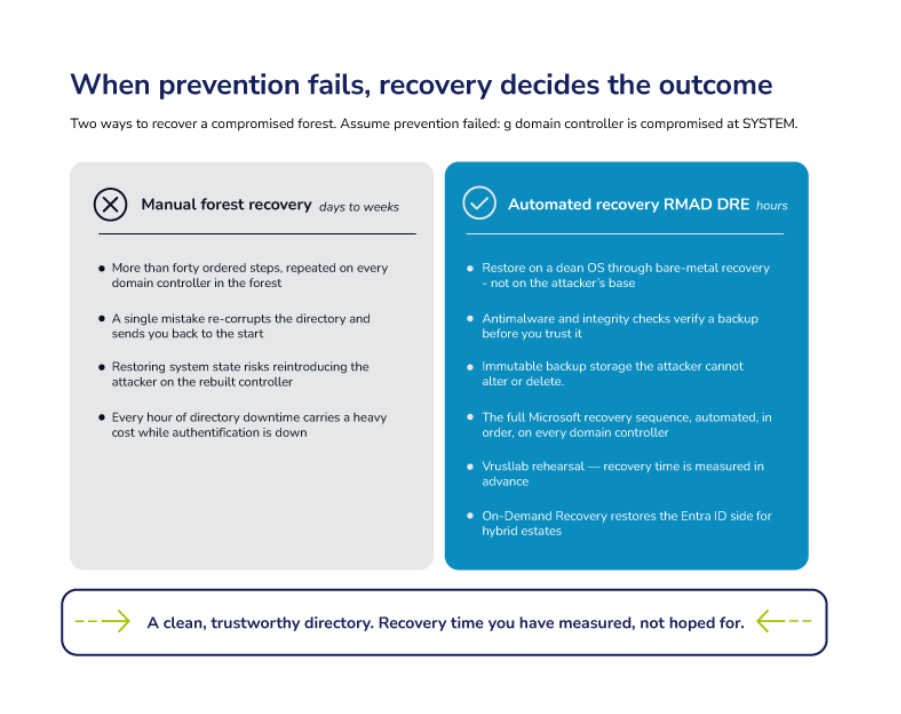
Quest Recovery Manager for Active Directory Disaster Recovery Edition runs the full Microsoft sequence automatically, in order, across every domain controller. ESG tested it and found it at least five times faster than manual recovery. Speed is only half of it. What you recover must also be clean, which is where RMAD DRE earns its keep:
- It restores to a clean operating system, so you are not rebuilding on top of whatever the attacker left behind.
- It runs antimalware and integrity checks against a backup before you trust it, exactly what you need when ransomware may already be sitting in older restore points.
- Backups can be held in immutable storage, so the attacker cannot tamper with or delete the one thing you need to recover.
- Recovery can be rehearsed in an isolated environment, so your recovery time is a number you have measured, not one you are hoping for.
For hybrid environments, on-premises forest recovery and Entra ID object recovery must function as a coordinated effort. On Demand Recovery handles the Entra ID side and works alongside Recovery Manager for Active Directory so the hybrid picture comes back as a single, coherent operation.
Build your Active Directory recovery before you need it
Realistically, you will not stop everything. A pre-authentication zero-day vulnerability on a domain controller is not preventable, especially if an attacker finds it before a patch exists.
What you can control is how fast you get back to a known-good state, and whether the backup you return to is clean. Patch this vulnerability now on every domain controller, then take a look at what you would do if you were hit. Could you recover?
Build your Active Directory recovery capability while things are quiet. The teams that walk away from a forest compromise and call it contained are the ones that decided, well before it happened, that recovery was the investment that mattered.