


Modern data teams don’t look the way they used to. Today’s modeling work involves data engineers, business analysts, data stewards, and AI consumers operating in parallel, often across time zones, often on tight delivery cycles, and frequently blocked waiting on a single expert practitioner. The tools and processes built for a different era of data work are creating real friction.
Data modeling sits at the center of this pressure. It’s the discipline that determines whether downstream analytics, semantic layers, and AI systems can be trusted. But the way modeling has traditionally been done, desktop-bound, expert-only, sequential, doesn’t fit the way data work actually happens now.
The shift happening in data organizations isn’t really about moving modeling to the cloud. It’s about redefining what modeling is for. It’s not just designing schemas. It’s about helping cross-functional teams continuously align on data meaning and structure at speed, with AI assistance, and with governance built in from the start. That’s what makes data trustworthy. That’s what makes AI dependable.
Today, Quest Software is answering that challenge with a tool built specifically for how modern data teams work.
What we’re launching
Quest Data Modeler is the new cloud-native, SaaS data modeler purpose-built for how modern data teams actually work today.
Quest Data Modeler combines AI-assisted modeling, real-time collaboration and enterprise-grade governance in a single, browser-based tool. It delivers governed definitions, naming standards, and conceptual-to-physical depth that every downstream tool, semantic layer, and AI system in your organization can depend on.
It’s backed by more than 30 years of data modeling heritage and expertise, and natively integrated into the Quest Trusted Data Management Platform. This is not a replacement for the modeling work that organizations may have already done within the erwin Data Modeler ecosystem, it is an extension of it, built for the situations in which traditional desktop modeling alone doesn’t quite fit anymore.
Why this matters now
Data architects, data engineers, and CDOs, will speak about the same pressures that are showing up repeatedly:
- Speed and delivery – The business is asking for trusted, AI-ready data at a pace that traditional, sequential “design-then-implement” cycles weren’t built for. Slow modeling cycles delay insights, stall data products, and create real organizational drag.
- Collaboration and alignment – Data modeling has traditionally been siloed and overly technical, limiting access for the users who consume its output. Business analysts, data stewards, and AI teams all depend on the model, but they aren’t usually in the model. The gap between business intent and technical implementation widens with every initiative.
- Governance and semantic drift – When “customer” and “revenue” mean different things across teams, every dashboard, report, and AI system inherits those inconsistencies. And AI doesn’t fix bad data foundations, it amplifies them.
Organizations cannot solve these problems with more diagrams. They solve them by changing how the modeling work itself is happening. Companies have to adjust who is participating, where the data lives, how fast it iterates and how tightly it can be integrated with the rest of your modern data stack.
That’s what Quest Data Modeler is built for.
What Quest Data Modeler delivers
AI-driven modeling
- How it works – Generate draft models from natural-language prompts, get auto-suggested joins and relationships, refactor with AI, and produce documentation without starting from scratch. Even build out data models from an image that can be dropped directly into the chat dialog.
- Business impact – Modeling work that once required days of expert time can now begin in minutes, lowering the barrier for engineers and analysts who understand the data domain but aren’t full-time modelers.
Browser-native real time collaboration
- How it works – Leverage multi-user editing, comments, and discussions on entities, Git-like versioning and shared semantic definitions. No installs, no version drift; architects, engineers, analysts, and other business stakeholders working in the same live environment.
- Business impact – The people who need to validate the model, business stakeholders and stewards, can now participate in it directly instead of waiting on a static export. That closes the gap between business intent and technical implementation.
Mart enterprise repository
- How it works – Centralize model storage with check-in/check-out, conflict resolution, version history, and standards enforcement at scale. No other cloud-based modeling tool has this level of repository. This can also directly connect the work of the technical teams that still need the legacy on-prem erwin Data Modeler for depth to directly connect their workflows to the model consumers on the business side.
- Business impact – This is the connective tissue between teams using Quest Data Modeler and teams still on erwin Data Modeler, so no part of the organization is working from a different version of the truth.
Conceptual, logical, and physical modeling in one place
- How it works – Trace end-to-end from business meaning to physical implementation, with forward and reverse engineering against modern cloud platforms like Microsoft Fabric, Databricks, and Snowflake.
- Business impact – When an AI system surfaces an anomaly or a dashboard shows unexpected numbers, teams can trace the issue back from physical structure to business meaning without switching tools or relying on documentation that may be out of date.
Modern stack integration
- How it works – Connect natively via dbt, git and REST APIs so that the tool can be built into the modern data stack, not another silo.
- Business impact – Data teams can add Quest Data Modeler to existing dbt, git, and API workflows without a rip-and-replace, removing the organizational friction that typically kills tooling adoption.
Together these capabilities shift modeling from static documentation to a living, intelligent system that continuously aligns business meaning with technical structure.
Meeting you where you are
The right modeling strategy depends entirely on what the modeling work actually looks like.
Some modeling is deeply complex, high stakes, and precision dependent. It is concentrated among expert practitioners who need maximum depth, control, and a decade of refinement in their tooling. For that environment, erwin Data Modeler continues to be the gold standard and is not going anywhere. The investments that a large portion of the market has made in their erwin practice are real and deserves to be protected.
Other modeling work happens in cloud-first, cross-functional environments on short delivery cycles, with data engineers, business stakeholders, and AI systems all awaiting output. For that work, requirements look very different and that’s exactly where Quest Data Modeler is the best fit.
Increasingly, the most sophisticated data organizations aren’t choosing one or the other. They’re running both: desktop precision for expert architects and cloud-native collaboration for everyone else, with the Mart repository serving as the common repository across both.
Only Quest can bring you both.
A third entry point for the Quest Trusted Data Management Platform
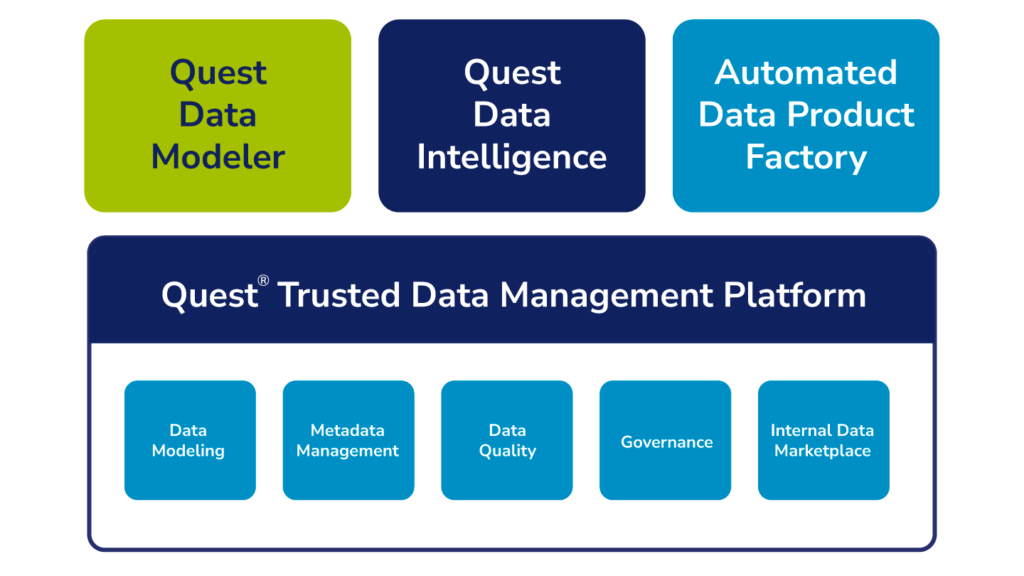
Quest Data Modeler is a native component of the Quest Trusted Data Management Platform – our unified, SaaS-native foundation that brings modeling, metadata management, governance, quality, and an internal data marketplace together for trusted, AI-ready data at speed and scale.
It’s the third entry point into the platform, to meet organizations where they are in their data maturity journey.
- Start with Quest Data Modeler if you want to build trusted data from the foundation up, with shared meaning baked in before downstream drift can take hold.
- Start with Quest Data Intelligence if your priority is building on that foundation, to bring trust and visibility to the data you already have
- Start with Automated Data Product Factory if you have mature foundations and are looking to deliver AI-ready data products to the business now and faster than ever
Go deeper
Here are a full set of resources to help you dig in today:
- See the product: Visit the Quest Data Modeler product page for more information and resources.
- Get the details: Download the Quest Data Modeler datasheet and the Data Modeling for Every Context comparison guide to see how Quest Data Modeler and erwin Data Modeler complement each other and how they differ.
- See the bigger picture: Explore the Quest Trusted Data Management Platform and how its components can deliver trusted, AI-ready data products.
- Talk to us: Request a demo and walk through how Quest Data Modeler would fit into your specific environment
Stop modeling tables. Start modeling meaning.